How it works

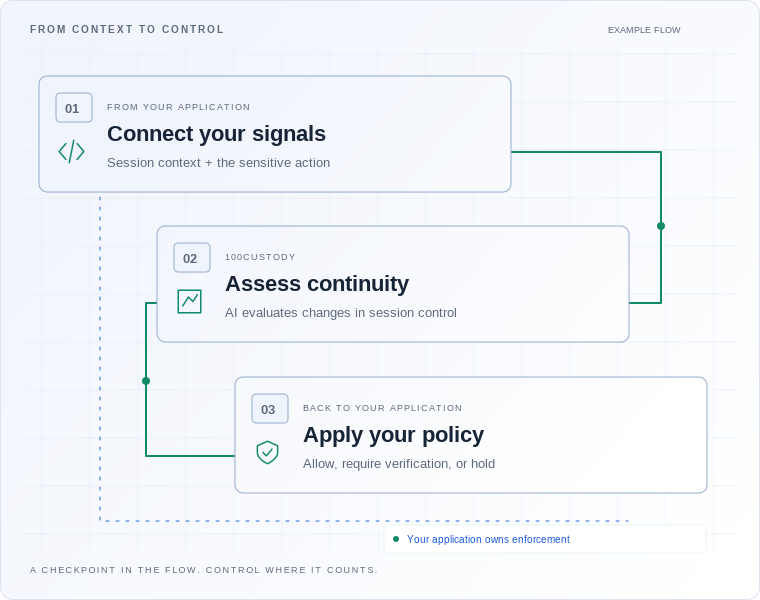
A checkpoint in the flow.
Control where it counts.

Connect relevant session context, assess continuity at a sensitive action, and let your application apply the response. The goal is a current identity decision at the point of consequence.

A connected workflow from application context to AI continuity assessment and application-owned policy enforcement
Connect context. Assess continuity. Apply your policy.
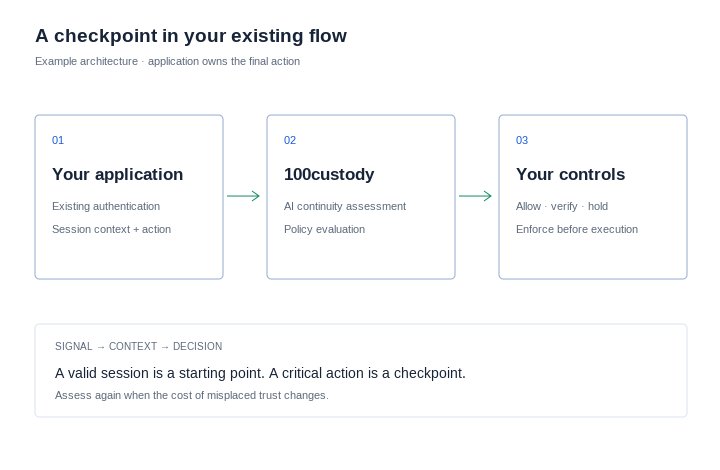
An application sends session and action context to 100custody and enforces the resulting policy
Illustrative architecture. Integration details and supported signals are agreed during discovery.
From intent to enforcement

Five steps. One clear decision.

Map the critical action.

Start with a specific operation: approving a payment, changing recovery details, exporting records, or granting a role. Identify the last point at which it can be paused.

You bring

The application owner, the action flow, and the business impact.

Connect relevant context.

Identify the session and action context your environment can make available. Collect only the information needed for the agreed assessment.

We scope together

Signal availability, data flow, identifiers, retention, and the integration boundary.

Assess continuity with AI.

Evaluate available evidence for changes in session control, alongside the sensitivity of the proposed action. Treat uncertainty explicitly.

The assessment informs

A policy decision. It is not an absolute proof of identity or a guarantee of safety.

Apply your response.

Your application uses the agreed policy to allow the action, request verification, or hold it for review. Define both the normal path and exceptions.

Your team controls

Enforcement, verification completion, review ownership, and release of a held action.

Review and refine.

Begin with observation where practical. Review examples, unnecessary friction, and missed context before expanding protection.

Agree on evidence

What will show that the checkpoint is useful, understandable, and operationally manageable.

An integration conversation, made concrete

Send context.
Receive a decision.
Keep ownership.

The example shows the shape of an action assessment. Your application identifies the session, names the action, and includes the relevant context.

Exact endpoints, payloads, authentication, and response contracts are confirmed during evaluation. This is an illustrative interface, not a published API contract.

Discuss your architecture
Illustrative integration
POST /v1/assess
{
  "session_id": "CX-8041",
  "action": "export_records",
  "context": {
    "record_count": 12482,
    "destination": "external_storage"
  }
}
Before production

Decide the edges of the workflow.

Timeouts and failures

Agree what the application does when an assessment or verification step cannot complete.

Enforcement boundary

Keep the final control server-side in the application. A browser-only check should not be the security boundary.

Review ownership

Name the reviewer, escalation path, and conditions for releasing a held action.

Event correlation

Keep the assessment, protected action, and verification result linked with suitable identifiers.

Observation criteria

Review representative sessions and policy outcomes before introducing an enforced checkpoint.

Data handling

Agree on necessary signals, access boundaries, retention, and deletion requirements.

Frequently asked questions

A few things
worth knowing.

More to discuss? Bring your questions to a product walkthrough.

Talk to us
Do you offer a plug-and-play integration for our provider?

Supported integration methods and providers should be confirmed during technical discovery. This site does not claim a certified connector or partnership with any identity vendor.

Can browser signals enforce security by themselves?

No. The protected application needs an enforcement point that cannot be bypassed by editing client-side code. Discuss the server-side action boundary during integration design.

What should we prepare for a technical walkthrough?

Bring a diagram or description of one sensitive workflow, your identity stack, the context available at the action, and the team responsible for enforcement.

Continuous identity assurance

Keep trust in the session.

See 100custody at your most critical checkpoint.

Book a demo