
Protect consequences, not just entry.
Prioritize the decisions that move money, expose information, change access, or authorize something difficult to undo.
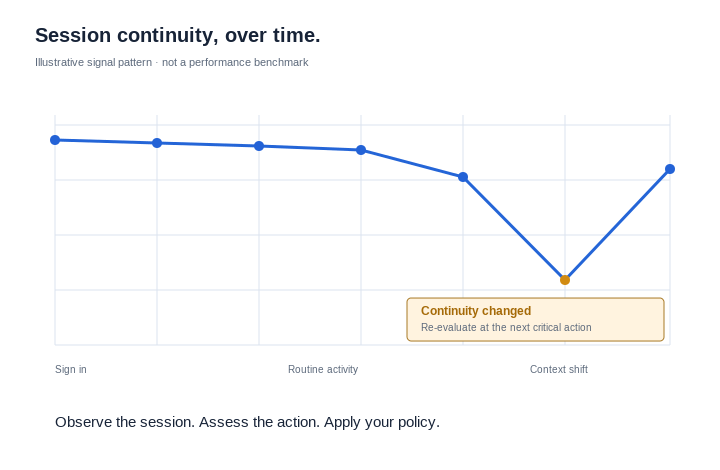
We’re focused on the gap between a valid session and a sensitive action. Because the person who authenticated may not be the person now in control.
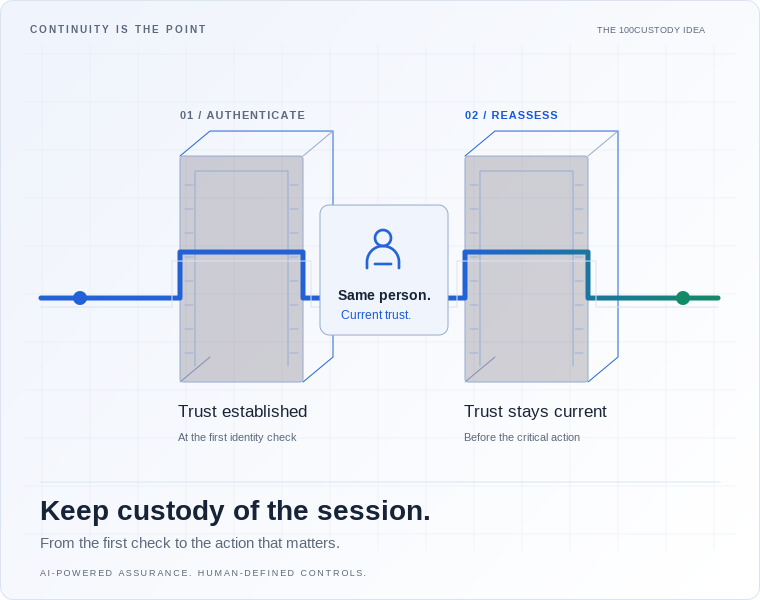
Authentication establishes a moment of trust. Critical actions need that trust to hold over time.
Applications grant sessions room to work. People navigate, edit, approve, and export long after the first identity check. During that time, control can change without a new login.
100custody brings AI-powered identity continuity into that interval. The focus is practical: help teams decide when a sensitive action needs more assurance before it proceeds.
Custody is about who has control. For identity security, that question extends beyond valid credentials to the person taking an action right now.
Our visual mark follows a continuous path through two checkpoints: an initial identity decision and a renewed check at a critical action. The path stays connected, just as trust should.
Prioritize the decisions that move money, expose information, change access, or authorize something difficult to undo.
Interpret available session context to help identify changes in control. Keep the assessment tied to a specific action and a response policy.
Make the evidence and limits understandable. Let security and application teams decide when to observe, verify, or review.
A useful first step is one important workflow with clear ownership. Learn from actual decisions before extending coverage.
Evaluate continuity risks, define verification policies, and understand why an action needs review.
Place a practical checkpoint in a real workflow, with clear control over how the application responds.
Connect the business impact of an action to an appropriate review or verification path.
See 100custody at your most critical checkpoint.