
Continuity assessment
Use AI to interpret available indicators of changes in session control.
100custody connects AI-powered session assessment with the actions that carry the greatest risk. Keep your identity provider. Add a checkpoint where trust needs to be current.
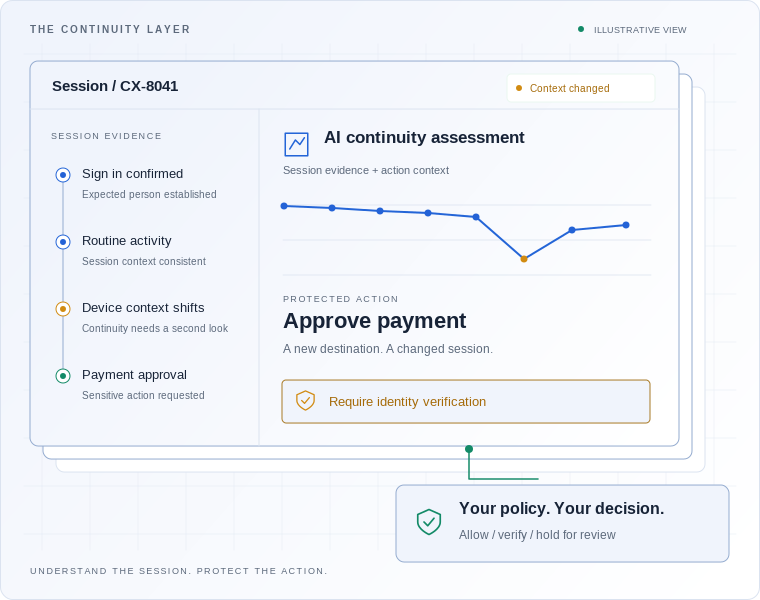
A valid session tells you authentication succeeded. It does not tell you whether the same person is still using it. Evaluate changes across available session signals to identify where trust needs another look.
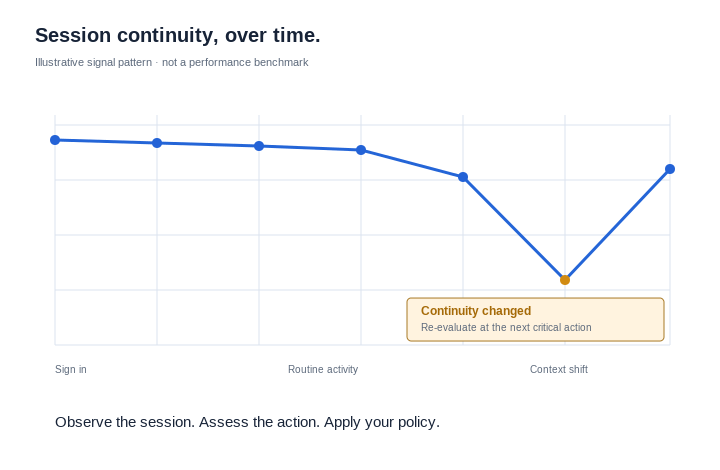
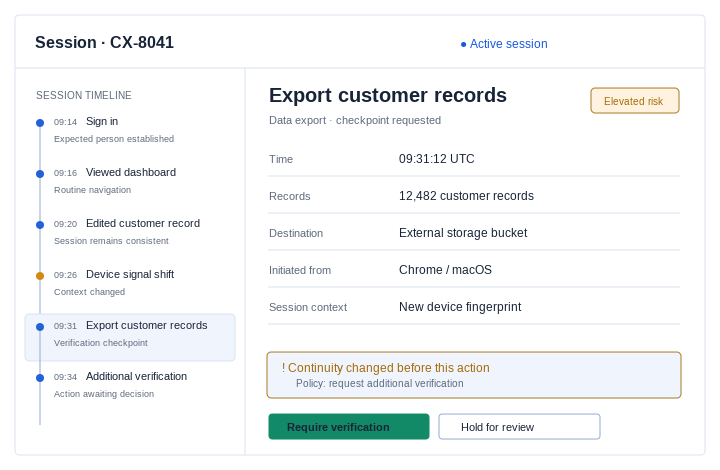
Opening a dashboard and exporting customer records should not carry the same trust requirement. Connect the sensitivity of an action with the state of the session before that action executes.
Your team defines when to observe, ask for verification, or stop an action for review.
Use a defined observation period to see how assessments map to real activity in your environment.
Route a sensitive action to an identity checkpoint when your policy calls for renewed assurance.
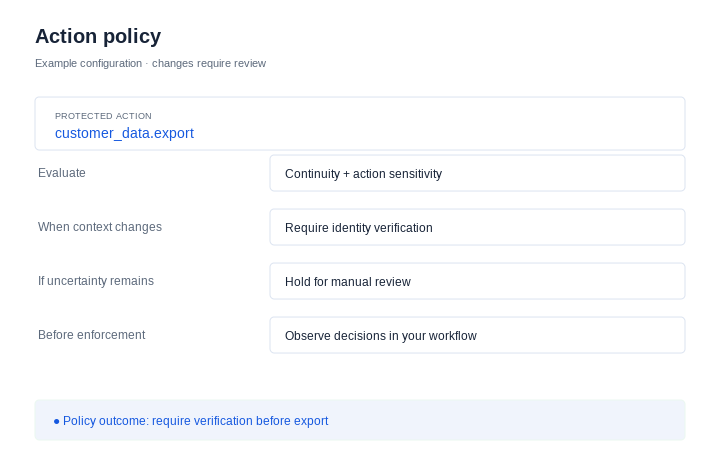
When an assessment needs human judgment, preserve the decision context and route the action to a reviewer.
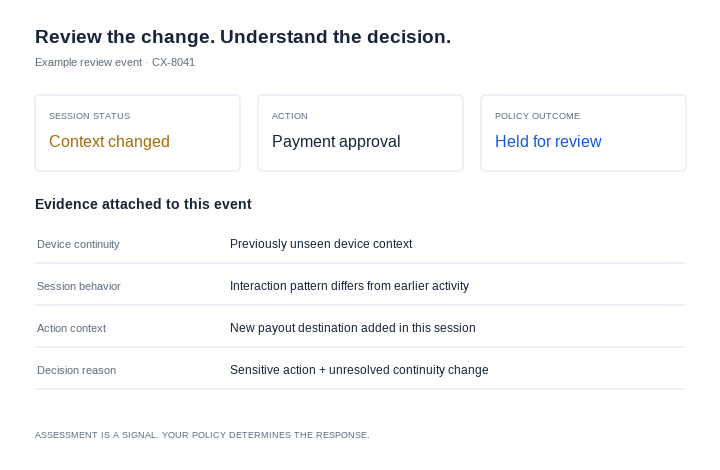
Use AI to interpret available indicators of changes in session control.
Describe what is about to happen and the business sensitivity it carries.
Define different responses for payments, exports, account changes, and approvals.
Assess usefulness in a scoped workflow before deciding where to enforce.
Connect an assessment to an allow, verification, or review path.
Keep relevant session changes close to the action that triggered review.
Your authentication provider establishes identity. Your application knows the action. 100custody is designed to connect the two with a current assessment of session continuity.
Integration methods, supported signals, and enforcement points should be agreed during technical discovery. The architecture shown here is illustrative.
Walk through the integration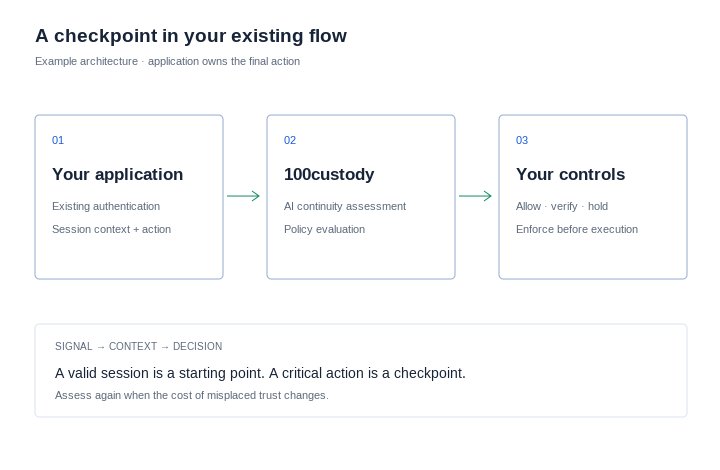
More to discuss? Bring your questions to a product walkthrough.
Talk to usNo. Define checkpoints for actions where uncertainty about session control has meaningful consequences. Routine navigation can remain outside the protected workflow.
Define an explicit fallback. Depending on the action, that could mean additional verification, a hold for review, or observation. Agree on this behavior before enforcing a policy.
No. An assessment expresses available evidence and uncertainty. It is an input to a policy, not a guarantee that a person or session is safe.
Discuss your verification flow during technical discovery. The intended architecture keeps your application responsible for enforcement, with verification and review paths designed around your environment.
See 100custody at your most critical checkpoint.